

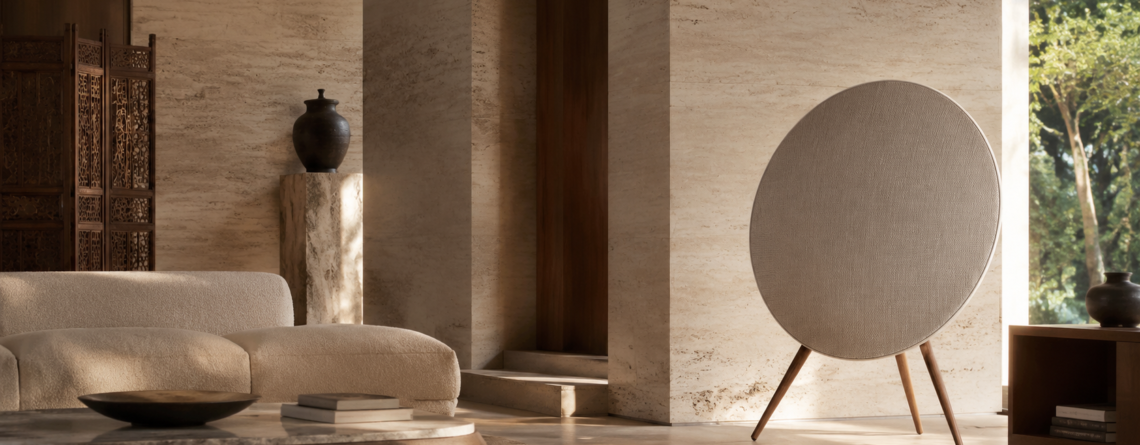
Can a Speaker Be the Best-Looking Object in Your Home? The Bang & Olufsen Difference
Why Buy a Bang & Olufsen Speaker? Sound, Design & Value
Most speakers ask for a compromise. Hide them and the sound may suffer. Display them and the room begins to look like an electronics store. Bang & Olufsen takes a more interesting position: what if the speaker did not interrupt the interior, but completed it?
That question explains much of the appeal behind a Bang & Olufsen speaker. B&O products are not designed as anonymous black boxes. They use proportion, material and sound as parts of the same experience. The result is audio equipment intended to be heard, touched and seen.
But beautiful design alone does not make a speaker worth owning. So, beyond the striking first impression, what actually makes a B&O speaker different—and is it the right choice for your home?
The short answer: why are Bang & Olufsen speakers different?
Bang & Olufsen speakers combine high-end sound engineering, room-aware audio technology, premium materials and furniture-like design. Selected connected models can analyse their position in a room and tune their output accordingly. Many newer models also use B&O’s modular Mozart platform, designed to support software evolution, servicing and future upgrades.
In simple terms, B&O is for someone who wants fewer compromises between sound, technology and interior design.
A speaker you do not need to hide
Traditional hi-fi culture often celebrates the machinery: visible drivers, stacked components, amplifiers and cables. That aesthetic has its audience, but it does not belong naturally in every home.
Bang & Olufsen approaches audio more like an architect or furniture designer. A circular speaker can become a visual anchor. A column can echo the vertical lines of a room. Aluminium, timber and woven textile can relate to surfaces already present in the interior.
This matters more than it may appear. A speaker performs best when it is placed thoughtfully—not squeezed into a cabinet simply because nobody wants to look at it. When the product belongs in the room visually, you are more likely to give it the space it needs acoustically.
That is the clever part of B&O design: beauty is not merely decoration. It can encourage better placement and, therefore, a better listening experience.
Your room is part of the sound system
People often compare speakers using driver counts, wattage or frequency figures. Those numbers are useful, but they leave out one enormous variable: the room.
Walls reinforce some frequencies. Soft furnishings absorb others. Glass, stone and large open areas can change the way sound reflects. Move the same speaker from a corner to the centre of a room and it may sound noticeably different.
On compatible Bang & Olufsen speakers, Active Room Compensation maps the acoustic surroundings and applies filters according to the speaker’s placement. It does not magically fix every difficult room, but it helps the speaker respond to the space in which it is actually used—not an ideal laboratory.
For modern Indian homes, that can be especially useful. An apartment living room, a double-height villa lounge and an open-plan living-and-dining space all behave differently. A room-aware speaker offers flexibility when the interior cannot be rebuilt around the audio system.
What does a Bang & Olufsen speaker sound like?
The better question is not “Does it have bass?” but “Does the sound remain composed when the music becomes demanding?”
A premium speaker should make quiet listening feel complete, preserve vocal clarity and keep instruments separated as volume rises. It should produce bass with shape rather than only impact. Most importantly, it should make you want to continue listening instead of constantly adjusting settings.
Different B&O models are built for different spaces, so there is no single sound description that replaces an audition. A compact speaker and a large statement speaker cannot create the same scale. However, the shared ambition is clear: wide, room-filling presentation without turning the home into a maze of equipment.
If possible, audition with three kinds of material:
- A familiar vocal track to judge naturalness and presence.
- A bass-rich track at both low and high volume to test control.
- A live or orchestral recording to hear scale, placement and detail.
Use music you know well. The most useful demo is not the most impressive recording—it is the one that makes differences easy for you to recognise.
Luxury that should outlive a trend
Connected speakers create an uncomfortable question: what happens when streaming and wireless standards change?
Bang & Olufsen’s answer is the Mozart platform used in a range of newer connected products. The platform is designed to be updated and improved over time, while its modular approach is intended to make servicing and future replacement of the streaming module possible. B&O also positions repair, reuse and long product life as central parts of its longevity strategy.
That does not make any connected product immortal, and buyers should always confirm the support and service terms for the exact model and market. It does, however, address a real luxury concern. An object made from lasting materials should not become irrelevant simply because one internal technology changes.
The most convincing form of luxury is not novelty. It is an object that continues to earn its place.
Which Bang & Olufsen speaker is right for your room?
Do not begin with the most expensive model. Begin with the room and how you listen.
For a compact room or secondary space
Look for a smaller connected speaker that can sit comfortably on a shelf, console or side table. Prioritise clear sound at everyday volume, easy streaming and unobtrusive placement.
For a main living room
A larger all-in-one speaker can create greater scale and bass presence while remaining visually integrated. Room compensation becomes valuable if placement is close to a wall or dictated by the furniture plan.
For a design-led statement
Choose a sculptural model when the speaker will function as part of the room’s composition. Consider finish samples alongside flooring, woodwork, upholstery and lighting—not only against a white showroom wall.
For whole-home listening
Check multiroom compatibility across every speaker you intend to connect. A well-planned system should let music follow you through the home without forcing every room to use the same size or form factor.
Is a Bang & Olufsen speaker worth the price?
A Bang & Olufsen speaker can be worth it when you value four things together: refined sound, distinctive design, premium materials and a streamlined ownership experience. If your only goal is maximum acoustic output per rupee, specialist component systems may offer a different value equation.
The B&O proposition is broader. You are buying sound, industrial design, craftsmanship, software and the freedom to place a speaker where people can actually see it.
Ask yourself:
- Will this be the main music system in the home?
- Does reducing cables and separate components matter?
- Is the product’s appearance important to the interior?
- Can the model comfortably suit the room size?
- Is authorised service available in your city?
- Have you heard it with your own music?
If most answers are yes, comparing it only with ordinary wireless speakers misses the point. Its closest alternatives may include a conventional hi-fi system, a piece of statement furniture and an integrated smart-audio setup—all at once.
Before you buy: a five-minute showroom test
Bring your phone and a short playlist. Ask the consultant to disable any exaggerated demo preset, if one is active. Listen first at the volume you use most often, then briefly at a higher level. Walk around the space and notice whether vocals remain clear. Try the app, adjust the sound and ask how room calibration works after installation.
Finally, request clarity on warranty, installation, software support and servicing in India. A luxury purchase should feel reassuring after the showroom visit, not only during it.
The final word
The most memorable technology often disappears into daily life. It does its job without demanding attention—until you choose to look at it.
That is where a Bang & Olufsen speaker makes its strongest case. It can fill a room without filling it with equipment. It can adapt to a space instead of asking the space to surrender. And when the music stops, it still has a reason to be there.
Perhaps the real question is not whether a speaker can be the best-looking object in your home. It is why something you use every day should be designed as anything less.
Frequently asked questions
Why is Bang & Olufsen so expensive?
The price reflects a combination of acoustic engineering, custom industrial design, premium materials, integrated software and detailed manufacturing. Buyers are paying for the complete object and ownership experience, not audio specifications alone.
Do Bang & Olufsen speakers work with Bluetooth and Wi-Fi?
Connectivity differs by model, but many current connected B&O speakers support Bluetooth, Wi-Fi streaming and multiroom features. Confirm the exact services and protocols on the product page for the model you are considering.
What is Active Room Compensation?
Active Room Compensation is a feature on compatible B&O speakers that acoustically maps the room around the product and applies filters to improve sound for its placement. It can generally be recalibrated if the speaker is moved.
Can I connect multiple Bang & Olufsen speakers?
Compatible B&O connected speakers can be used in a multiroom system, allowing the same music to play across spaces or different audio to play in individual rooms. Compatibility should be checked before combining products from different generations.
Are Bang & Olufsen speakers good for large rooms?
Some models are designed to deliver substantial room-filling sound, but suitability depends on the specific model, room volume, layout and listening level. A showroom or in-home consultation is the safest way to match the speaker to a large space.
Where should I place a B&O speaker?
Follow the placement guidance for the model and avoid enclosing it in furniture unless the product is designed for that use. If the model includes room compensation, recalibrate it whenever you move the speaker.