

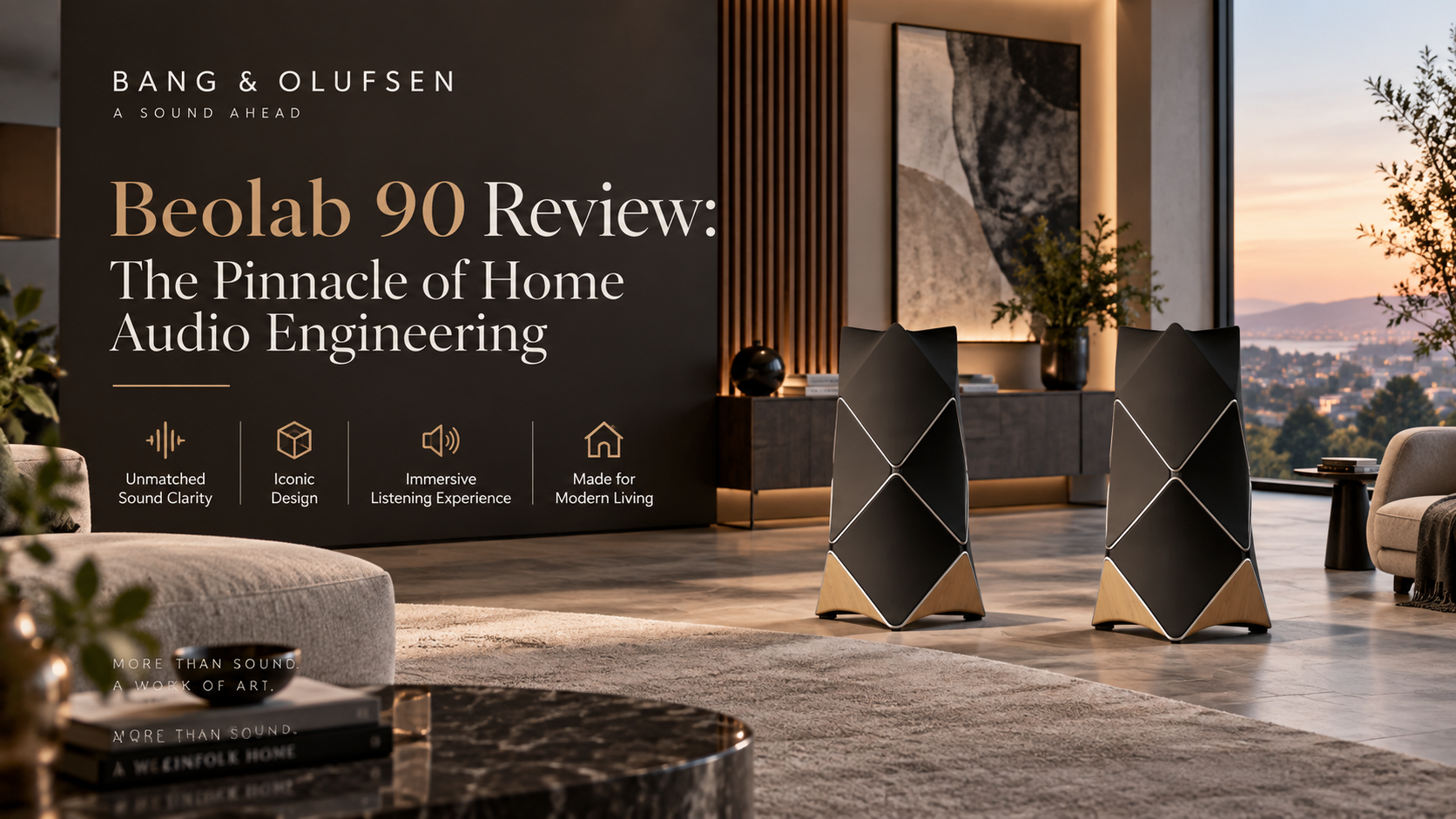
Bang & Olufsen Beolab 90 Review: The Pinnacle of Home Audio Engineering
A 6.5-inch woofer hidden inside a sculpted aluminum column might seem impossible until you hear it. Priced from $21,200 per pair, the Bang & Olufsen Beolab 28 bridges the gap between architectural minimalism and serious full-range audio. Most luxury speakers force you to choose between aesthetics and acoustic performance; this model attempts to hand you both.
For the team at Sera Casdim, the Bang & Olufsen Beolab 28 represents a specific shift in high-end residential audio. It moves the conversation away from bulky wooden cabinets toward active, wireless systems that genuinely integrate into modern domestic architecture.
What Makes the Bang & Olufsen Beolab 28 a Top-Tier Wireless Speaker?
The Bang & Olufsen Beolab 28 earns its top-tier status by combining a dedicated down-firing woofer, advanced acoustic lens technology, and the Mozart platform into a single wireless column. It delivers full-range sound without requiring an external subwoofer, solving a problem that plagued its predecessors.
The Philosophy Behind the Acoustic Design
Previous iterations of B&O column speakers, notably the Beolab 18, lacked the physical cabinet space to move enough air for believable low-frequency response. Audiophiles often compensated by adding a separate subwoofer. As noted in a demonstration by Bang & Olufsen of Birmingham, adding a separate subwoofer historically disrupted the cohesive setup that music lovers desired. The Bang & Olufsen Beolab 28 fixes this by integrating a dedicated woofer at the base, producing tight, integrated bass straight out of the box.
This integration stems from a deliberate design philosophy. B&O wanted a speaker that takes up minimal floor space but provides a broad, room-filling soundstage. According to Definitive Audio, the Bang & Olufsen Beolab 28 allows users to narrow the wooden grilles for a focused listening sweet spot or open them wide for movies and social gatherings. That directional control separates it from standard hi-fi towers.
Integration of Digital and Mechanical Engineering
Inside the Bang & Olufsen Beolab 28, digital signal processing constantly manages the drivers. The active crossover ensures the tweeter, midrange, and woofer receive precisely tailored frequencies. The acoustic lens technology handles the high-frequency dispersion. By shaping the physical lens around the tweeter, the engineers guarantee that higher frequencies project evenly across the listening area rather than beaming straight forward.
Because the amplification lives inside the cabinet, the signal path stays entirely digital from the source to the drivers. This removes the need for external speaker cables and power-hungry amplifiers. The result of this mechanical and digital marriage is a column speaker that behaves like a focused studio monitor but functions as a whole-home audio solution.
Is the Beolab 28 the Best Speaker for a Large Living Room?
Yes, the Bang & Olufsen Beolab 28 qualifies as the best speaker for a large living room if your priorities involve open-concept architecture and eliminating unsightly audio clutter. It handles spatial audio distribution effectively through integrated room compensation software, forcing sound into the room rather than letting it bounce blindly off the nearest wall.
Active Room Compensation and Spatial Sound
Acoustic treatment in large residential spaces presents a massive challenge. Hard surfaces, vaulted ceilings, and glass walls reflect audio unevenly. The Bang & Olufsen Beolab 28 features Active Room Compensation to measure and correct these anomalies. By analyzing the room’s acoustics, the speaker adjusts its output to minimize the negative impact of nearby walls. You can place the speaker in a corner, and the DSP will tune the bass response so it does not sound muddy or boomy. This level of spatial adaptation is critical for spacious layouts where traditional passive speakers fail to image correctly.
Filling the Space Without Overwhelming the Decor
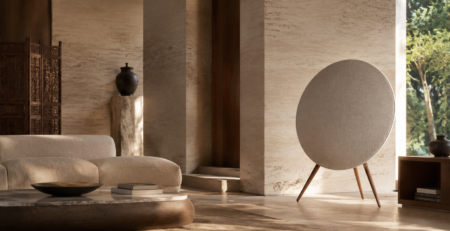
Standard floorstanding speakers demand significant floor area and create visual clutter. A large living room requires sound that reaches every seating position, but you cannot simply place massive box speakers in the middle of an open floor plan without ruining the aesthetic. According to the manufacturer, the Bang & Olufsen Beolab 28 provides “powerful, studio-quality sound that adapts to your room” within an elegant, slender form. By using a tall, narrow footprint, it disrupts sightlines far less than traditional tower speakers. It fills the acoustic void perfectly.
How Does the Beolab 28 Function as a Slim Luxury Floorstanding Speaker?
The Bang & Olufsen Beolab 28 operates as a slim luxury floorstanding speaker by housing its drivers vertically within a narrow cylindrical cabinet wrapped in interchangeable materials. This architectural approach allows it to occupy minimal square footage while projecting expansive stereo soundscapes, effectively acting as functional decor rather than an intrusive audio box.
Material Choices: Natural Aluminum, Oak, and Fabric
The cabinet exterior directly dictates how the speaker interacts with a room’s visual identity. The Bang & Olufsen Beolab 28 utilizes natural aluminum for its core structure, paired with interchangeable covers in light oak, smoked oak, walnut, or grey fabric. You can swap these outer covers to match changing interior design trends without replacing the speaker. This modularity ensures the speaker looks at home alongside warm wood paneling or cool minimalist concrete. Sera Casdim recognizes this material flexibility as a primary reason clients with dedicated interior architects choose this system.
Floor-Standing and Wall-Mounted Configurations
Flexibility in placement is rare among tower speakers. The Bang & Olufsen Beolab 28 functions as a floor-standing unit on a dedicated base, but it also includes a dedicated wall mount bracket. This allows the columns to hover alongside a mounted television or architectural column. If you move homes or redesign the space, the speakers transition from floor to wall without purchasing new hardware. Sera Casdim notes that this dual-mounting ability solves the dilemma for homeowners who want elevated sound without floor-standing footprints.
Which Is Better: The Beolab 28 or the KEF LS60?
The Bang & Olufsen Beolab 28 is better for buyers who prioritize modular aesthetics, directional sound control, and design flexibility, while the KEF LS60 Wireless is better for listeners who want a slightly warmer, traditional hi-fi sound profile with massive bottom-end weight. The choice ultimately depends on whether you value architectural integration or sheer acoustic output.
Comparing Acoustic Delivery and Sound Staging
Both systems rely on active wireless technology, but their acoustic approaches differ. The LS60 uses KEF’s Uni-Core technology, stacking drivers to create a broad, unified soundstage with immense bass depth. The Bang & Olufsen Beolab 28 relies on Acoustic Lens Technology to manipulate high-frequency dispersion. It offers a narrower, more focused sweet spot when desired, which the LS60 does not easily replicate. According to Steve from Sounds Heavenly, speaking with Bang & Olufsen of Birmingham, the Bang & Olufsen Beolab 28 captures details down to “the breath of the artist,” providing a level of vocal clarity that stands up to traditional audiophile setups.
Aesthetic Differences and Smart Feature Integrations
Visually, the KEF LS60 presents a wide, heavy rectangular cabinet designed to sit firmly on the floor. The Bang & Olufsen Beolab 28 presents a slender, architectural column. B&O’s integration of the Mozart platform allows the Bang & Olufsen Beolab 28 to integrate flawlessly with existing B&O televisions and multi-room systems using Beoconnect Core. The KEF system integrates well with standard streaming protocols but lacks the native ease of integration found within the B&O ecosystem.
Why Is Bang & Olufsen Considered a Luxury Audio Brand?
Bang & Olufsen is considered a luxury audio brand because it couples proprietary acoustic engineering with uncompromising Scandinavian industrial design, ensuring every product serves as a functional piece of architectural decor rather than a standard electronic device. The brand produces audio equipment that explicitly targets the high-end architectural and interior design markets.
Heritage of Scandinavian Design and Craftsmanship
For nearly a century, B&O has collaborated with leading industrial designers to create audio equipment that breaks the traditional rectangular mold. The Bang & Olufsen Beolab 28 continues this heritage. By utilizing natural aluminum and real wood veneers, B&O insists on materials that age gracefully. The speakers look less like mass-market electronics and more like commissioned furniture pieces. This dedication to craftsmanship justifies the premium pricing model. You pay for the acoustic engineering and the material refinement.
Justifying the Investment in Premium Floorstanding Speakers
Priced at $21,200 for a pair, the Bang & Olufsen Beolab 28 represents a serious financial commitment. However, the investment makes sense when you factor the cost of separate amplification, acoustic treatment, and interior design consultation into traditional hi-fi setups. Standard high-end passive speakers require massive external amplifiers that generate heat and demand dedicated equipment racks. The Bang & Olufsen Beolab 28 contains all amplification internally. It bypasses the need for external hardware, reducing cable clutter and installation complexity.
Can You Provide a Detailed Review of the Beolab 28’s Performance?
A detailed review of the Bang & Olufsen Beolab 28’s performance reveals a speaker that resolves low frequencies with unexpected authority while maintaining pristine, breath-catching vocal clarity in the mid and high registers. It performs exactly like a full-range audiophile column should, defying its narrow proportions.
Bass Response and Low-Frequency Handling
Earlier B&O column speakers lacked serious bass. The Bang & Olufsen Beolab 28 fixes this by introducing a separate woofer at the base. During evaluations, this integrated driver produces low frequencies that you feel rather than just hear. Active Room Compensation ensures the bass does not overpower the room or cause room nodes to pile up in the corners. By keeping the bass tightly integrated within the column itself, the speaker avoids the disconnected feeling that plagues systems relying on separate subs.
Mid-Range Clarity and High-Frequency Dispersion
The mid-range dictates how realistic vocals and instruments sound. The Bang & Olufsen Beolab 28 reproduces vocals with startling accuracy. The acoustic lens technology manages the high frequencies, widening the sweet spot so the soundstage does not collapse when you stand up or move to another seat. This wide dispersion makes the system exceptionally effective for home cinema use, where listeners occupy multiple seating positions across a room.
Where Can You Buy a Premium Floorstanding Speaker in India?
You can acquire a premium floorstanding speaker in India through authorized high-end audio dealers and luxury electronics boutiques located in major metropolitan areas. The Indian market for luxury audio has expanded heavily, with dedicated spaces offering private listening rooms for high-fidelity demonstrations.
Availability of High-End Audio Solutions in the Indian Market
Dealerships in Mumbai, Delhi, and Bangalore regularly stock Bang & Olufsen products. The Bang & Olufsen Beolab 28 represents the exact type of premium floorstanding speaker India seeks for modern luxury apartments and villas. These dealers provide custom installation services, ensuring the wireless architecture integrates cleanly with existing smart home systems. You will not find this tier of equipment in standard electronics megastores. High-end audio requires dedicated acoustic environments to properly audition the speakers before purchase.
What to Consider When Purchasing Luxury Audio Equipment
Before buying a system like the Bang & Olufsen Beolab 28, evaluate your room acoustics, wireless network stability, and spatial layout. Luxury active speakers rely heavily on a stable network for high-resolution streaming. Consider how the speaker’s aluminum and oak finishes will complement your existing furniture. Most importantly, arrange a private listening session at an authorized boutique. You need to hear how the Active Room Compensation and acoustic lens technology translate to your specific musical preferences before committing to the investment.
Why Is Bang & Olufsen So Expensive?
Bang & Olufsen commands high prices because the brand invests heavily in proprietary acoustic research, bespoke industrial design, and premium material engineering. Each speaker undergoes rigorous testing to meet audiophile standards while maintaining the visual aesthetic of high-end Scandinavian furniture. The cost covers the integrated amplifiers, advanced digital signal processing, and the architectural impact of the piece.
Which Is Better, the Beolab 28 or the KEF LS60?
The KEF LS60 Wireless delivers heavier, broader bass and a more traditional floorstanding footprint. The Bang & Olufsen Beolab 28 provides a slenderer profile, directional sound control, and seamless integration with B&O televisions. Choose the LS60 for pure sonic mass; choose the Bang & Olufsen Beolab 28 for architectural flexibility and detailed vocal clarity.
Is Bang & Olufsen a Luxury Brand?
Yes. Bang & Olufsen operates firmly in the luxury sector. The brand pairs high-resolution audio engineering with materials like natural aluminum, oak, and fabric, ensuring its products function as statement pieces. The Bang & Olufsen Beolab 28 serves as a prime example of this philosophy, combining elite acoustic technology with bespoke visual design.
Can You Provide a Review of the Beolab 28 Speaker?
Our review finds the Bang & Olufsen Beolab 28 highly effective for large spaces and home cinema setups. It produces deep, integrated bass without a separate subwoofer. The mid-range captures intricate vocal details, and the Acoustic Lens Technology creates a wide, room-filling soundstage. It performs exceptionally well for listeners who require both high-fidelity audio and strict architectural aesthetics.
If you are ready to integrate uncompromising audio into your living space, connect with the team at Sera Casdim today to arrange a private consultation.
Key Takeaways
- The Beolab 28 bridges the gap between architectural minimalism and full-range audio without requiring external subwoofers.
- Active Room Compensation analyzes your space to prevent bass from sounding muddy, making it ideal for open-concept layouts.
- Interchangeable oak and fabric covers allow the speaker to adapt to changing interior design trends over time.
- Compared to the KEF LS60, it offers superior vocal clarity and modular aesthetics rather than sheer acoustic mass.
- Sera Casdim recommends it for buyers seeking a slim luxury floorstanding speaker that integrates seamlessly into smart homes.
Comparison
| Feature | Bang & Olufsen Beolab 28 | KEF LS60 Wireless |
| Form Factor | Slender architectural column | Wide, heavy rectangular cabinet |
| Acoustic Technology | Acoustic Lens Technology | Uni-Core Driver Technology |
| Bass Handling | Integrated down-firing woofer | Massive bottom-end weight |
| Mounting Options | Floor-standing or wall-mounted | Floor-standing only |
| Ecosystem Integration | Mozart platform & Beoconnect Core | Standard streaming protocols |
| Best For | Architectural flexibility & decor | Traditional hi-fi sound profile |
Frequently Asked Questions
- Why is Bang & Olufsen so expensive?
Bang & Olufsen commands premium prices because the brand invests heavily in proprietary acoustic research, bespoke industrial design, and high-end material engineering. The cost covers integrated amplifiers, advanced digital signal processing, and the architectural impact of crafting audio equipment that functions as luxury furniture. - Which is better, the Beolab 28 or the KEF LS60?
The KEF LS60 Wireless delivers heavier bass and a traditional floorstanding footprint. The Bang & Olufsen Beolab 28 provides a slender profile, directional sound control, and seamless integration with existing architectural ecosystems. Choose the LS60 for pure sonic mass, or the Beolab 28 for design flexibility. - Is Bang & Olufsen a luxury brand?
Yes, Bang & Olufsen operates firmly in the luxury sector. The brand pairs high-resolution audio engineering with premium materials like natural aluminum, oak, and fabric. Their products function as statement pieces of architectural decor, justifying their luxury status for homeowners and interior designers seeking uncompromising aesthetics. - Can you provide a review of the Beolab 28 speaker’s performance?
The Beolab 28 resolves low frequencies with unexpected authority using a dedicated down-firing woofer, while maintaining pristine vocal clarity in the mid and high registers. Active Room Compensation prevents bass from overwhelming the space, and acoustic lens technology ensures a wide, room-filling soundstage. - Is the Beolab 28 the best speaker for a large living room?
Yes, the Beolab 28 is ideal for large living rooms due to its Active Room Compensation technology. This feature measures and corrects acoustic anomalies from hard surfaces and vaulted ceilings, ensuring immersive sound reaches every seating position without requiring bulky, visually intrusive speaker cabinets.


Leave a Reply